ActLume blog
Incident manager articles
CRA Article 14 guidance written for the incident manager workflow role.
Incident manager articles
11 available
-
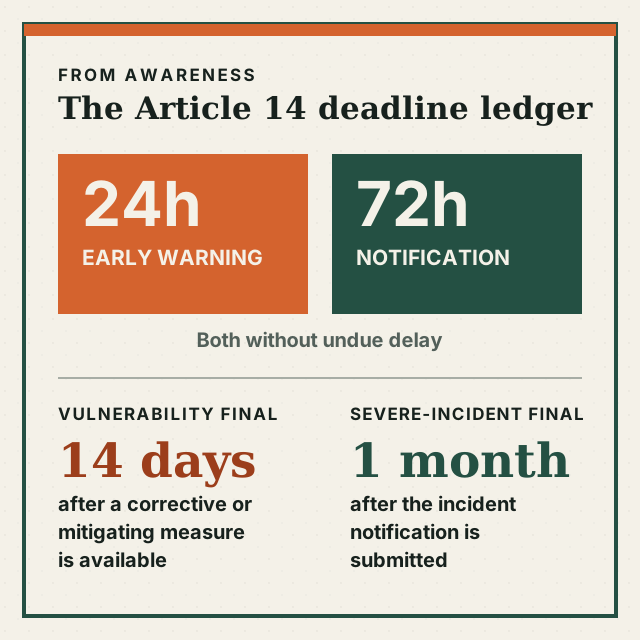 What must a manufacturer report under CRA Article 14, and when is each stage due?
CRA Article 14 reporting stages and deadlines
Both Article 14 tracks start with 24-hour and 72-hour stages, but their final-report clocks start from different events.
-
 When does the CRA Article 14 reporting clock start for a manufacturer?
When does the CRA Article 14 clock start?
The CRA Article 14 clock starts when an initial assessment gives the manufacturer reasonable certainty that an actively exploited vulnerability or severe incident meets the reporting trigger.
-
 How should a manufacturer test whether an incident is severe under CRA Article 14?
The CRA severe product-security incident test
Article 14 treats an incident as severe when it meets either of two product-security impact tests concerning protected data, functions, or malicious code.
-
 What starts the CRA deadline for an actively exploited vulnerability final report?
When is the CRA vulnerability final report due?
The final report for an actively exploited vulnerability is due no later than 14 days after a corrective or mitigating measure becomes available.
-
 Why should a manufacturer assess the two CRA Article 14 reporting tracks separately?
The CRA has two Article 14 reporting tracks
Article 14 separately covers actively exploited vulnerabilities and severe incidents affecting product security, with distinct final-report rules.
-
 How should a manufacturer preserve and reconcile the timestamps behind a CRA awareness record?
Record the CRA awareness timestamp
A CRA awareness record needs more than one timestamp. Preserve raw source and receipt times, record clock quality, and explain how the chosen instant was normalised to UTC.
-
 When must a final-product manufacturer report an actively exploited vulnerability in a third-party component?
When a component triggers CRA reporting
A supplier's exploited flaw does not answer the final-product question; the manufacturer must establish whether its own product contains and is affected by it.
-
 How should a manufacturer map a vulnerable component to affected product versions for CRA reporting?
Map vulnerable components to CRA product versions
CRA reporting needs product-specific information, so component evidence must resolve to shipped product versions rather than stop at a dependency name.
-
 How should a manufacturer decide whether an enterprise security incident is also a CRA severe incident affecting a product?
Separate product security and enterprise incidents
CRA severe-incident reporting concerns an incident that affects or can affect a product's ability to protect specified data or functions, or enables malicious code.
-
 How should an organisation assess the same security event under both the CRA and NIS2?
Triage one event under both the CRA and NIS2
The same security event can require separate assessment under the CRA's product-manufacturer test and NIS2 rules applying to an affected entity.
-
 How should a manufacturer prepare older products for CRA Article 14 reporting?
Bring legacy products into CRA reporting triage
CRA Article 14 reporting applies to in-scope products made available before 11 December 2027, not only to products launched after the main application date.